Introducing Tazo: the audio decision model for voice agents
Your voice agent can get every word right and still get the call wrong. Tazo listens to the call audio and decides what happens next: speech in, decision out.
- Author
- Tazo Labs
- Published
- Reading time
- 6 min read
Today we’re launching Tazo, an audio decision model for live voice agents. Give it raw call audio, a text prompt and your options, and it returns a calibrated probability for each option, directly from the audio. The API is live, and every new sign-up gets free credits.
 Watch on YouTube: the Tazo launch video
What is Tazo?
Tazo is an audio decision model. It listens to a conversation and picks from a set of options you define, such as respond, wait, escalate, or which tool to call. It doesn’t write text and it doesn’t transcribe. Each answer comes with a probability you can set a threshold on.
Most voice agents turn speech into text first and ask a text model to decide. That works until the decision depends on something a transcript drops: tone, pauses, a second voice, background noise. Tazo decides from the audio itself. For the longer explanation, see What the heck is an audio decision model?
What’s in the launch
- 70.9% vs 46.4%. Tazo against STT plus Jev on real production calls.
- #2 on MMAU. Second among 30 models on the MMAU audio intelligence benchmark.
- Under 200 ms model latency. Fast enough to run on a live call.
- Built for streaming voice calls. The first decision model tuned to run on a call while it’s still happening.
- “None of the above.” A built-in option for out-of-scope and unsure states.
- API live, free credits. Every new sign-up gets free credits at app.tazolabs.com.
How Tazo works
You send Tazo three things: the call audio, a text prompt that says what you want to know, and the list of options. Tazo returns a probability for each option.
Because the options are an input, one model covers many decisions. A new decision is a new option list, not a new model to train.
“None of the above” is the part we think matters most in production. Callers say things your options don’t cover, and sometimes the audio is simply unclear. Without an escape hatch, a model has to pick the least wrong option. With it, Tazo can say “this isn’t any of those” and your agent can ask again, hand off or stay quiet.
How Tazo compares on real calls
We tested Tazo on 4,867 questions across 1,081 audio clips from real production calls from Bolna, covering 32 decision tasks. The baseline is a speech-to-text model feeding Jev, a text decision model. Tazo scored 70.9% overall. STT plus Jev scored 46.4%.
The gap is widest on decisions that live in the voice. On caller emotion, Tazo scored 67.3% and STT plus Jev scored 0.6%. On background noise and interference, it was 74.6% vs 0.0%. On counting how many people are speaking, 93.7% vs 27.5%. A transcript has no way to answer those.
It isn’t a clean sweep, and we publish that too. On some tasks that mostly depend on the words, such as lead engagement and next-turn prediction, the text pipeline scores higher. The benchmark site has every task, including those.
On MMAU, a public audio understanding benchmark, Tazo ranks second of 30 models on the combined Speech and Sound score, at 79.48%. For how Tazo differs from Jev, see Tazo vs Jev.
Five things you can build with Tazo
1. Speculative tool calling
Tazo predicts the tool call while the caller is still talking, so your agent can fire it early. If the LLM later asks for the same call, the result is already waiting. Less dead air.
In the demo, Tazo tracks whether the caller is talking, making noise or silent, and which function should run next: stop_talking(), end_call(emotion, interest) or send_offer_details_to_mobile().
 Watch on YouTube: speculative tool calling demo
Read more: Speculative tool calling: the next big thing in voice AI.
2. Graph agents
Most of a voice agent’s job is knowing where the call is and where it should go next. Tazo scores every possible next step from the audio, so each move is a logged decision with a probability, not a silent guess.
The demo is a customer support router. A call starts at “Welcome and triage” and Tazo scores the options: billing, delivery and tracking, returns and refunds, a human specialist or a callback offer.
 Watch on YouTube: graph routing demo
Read more: How audio decision models make graph agents reliable.
3. User profiling
How is the caller feeling? How urgent or frustrated are they? What language are they speaking? How many people are on the line? Tazo answers these from the voice, not the transcript. On caller emotion, that’s 67% vs 1% for STT plus Jev.
The demo runs on Hindi and English calls, including a frustrated Hindi caller, and returns an answer, a confidence and review flags for each annotation.
 Watch on YouTube: user profiling demo
Read more: What the heck is an audio decision model? covers emotion, language and speaker questions in the list of things Tazo can decide.
4. Post-call analytics
Stop reading calls through transcripts. Ask the recording directly: “Was the caller frustrated before the transfer?” or “Was there background noise when they hung up?” Tone, pauses and noise only show up in the audio.
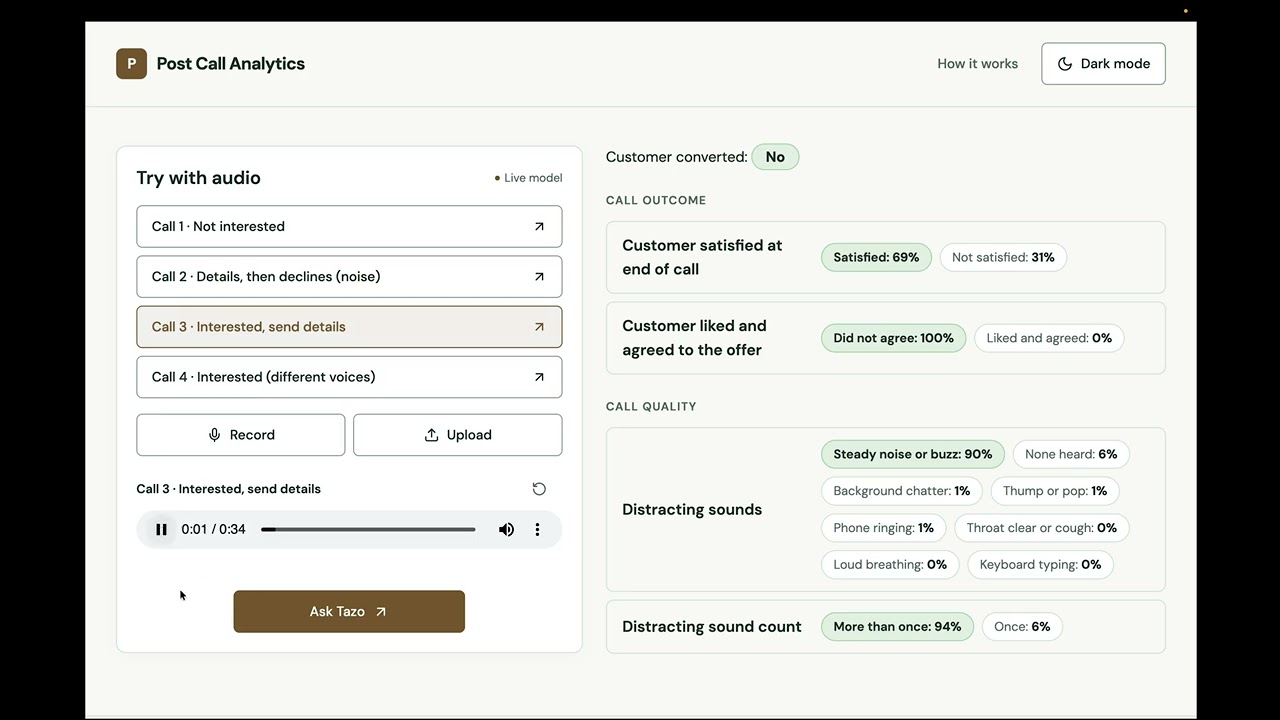 Watch on YouTube: post-call analytics demo
Read more: Post-call analysis: query your calls, not just transcripts.
5. Computer use
Say it, and it’s done. In the Tazo Assistant demo, Tazo turns a spoken command into the action on screen while you’re still talking. There’s no transcribe, then parse, then click.
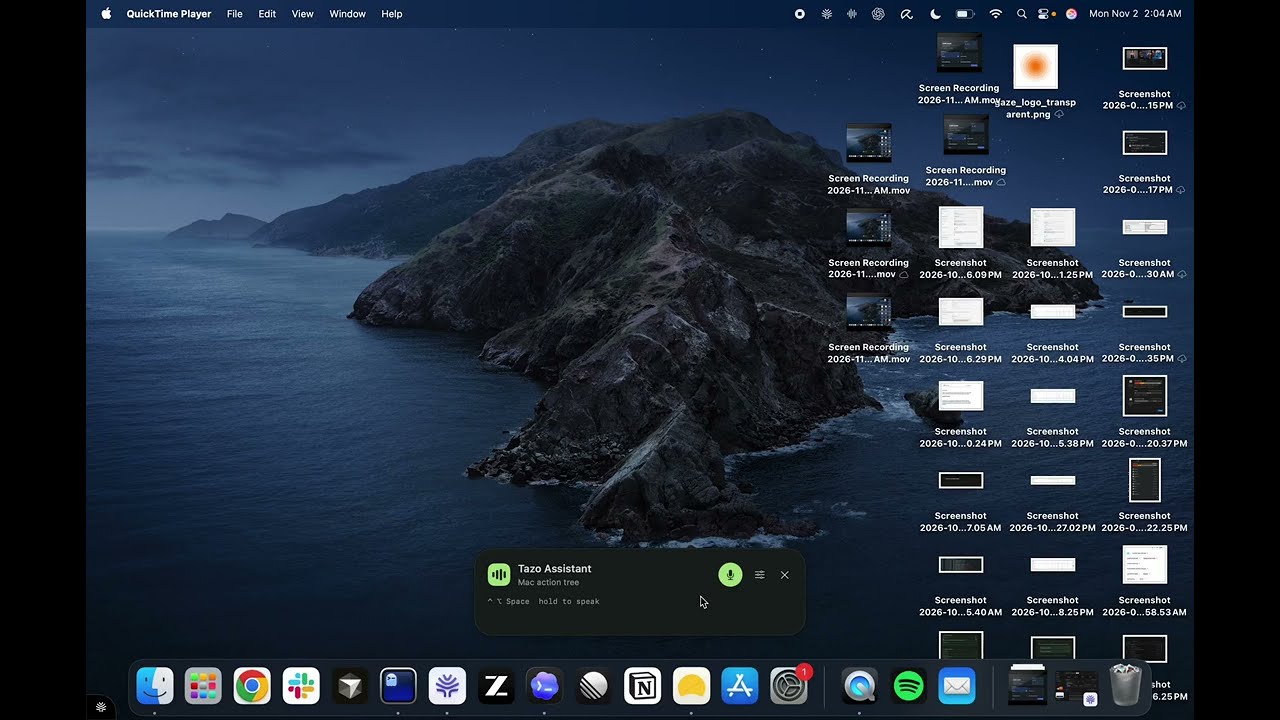 Watch on YouTube: Tazo Assistant computer use demo
Read more: Stop making your personal AI agent transcribe first.
Frequently asked questions
What is Tazo?
Tazo is an audio decision model for live voice agents. It takes raw call audio, a text prompt and a list of options, and returns a calibrated probability for each option.
How is Tazo different from a speech-to-text model?
A speech-to-text model turns audio into words. Tazo skips the words and answers a question about the audio, such as whether the caller is frustrated or what the agent should do next. That’s why it can pick up tone, pauses and background noise.
How is Tazo different from an LLM?
An LLM writes text one token at a time. Tazo picks from a fixed set of options in a single step and returns a probability for each, so it’s faster and its output plugs straight into code.
How fast is Tazo?
Model latency is under 200 ms.
What does “None of the above” do?
It’s a built-in option for out-of-scope and unsure states. When the audio doesn’t match any of your options, or Tazo can’t tell, it can pick “None of the above” instead of forcing a wrong answer.
How does Tazo compare with Jev?
On real production calls, Tazo scored 70.9% overall against 46.4% for STT plus Jev. Jev decides from text, so it needs a transcript first. See Tazo vs Jev for the full comparison.
How do I get started with Tazo?
Sign up at app.tazolabs.com. Every new sign-up gets free credits. The docs cover the API.
Give your agent ears
The Tazo API is live. Create an account to try it with your own calls and options, read the docs, or see the full results on the benchmark site.
Speech in, decision out.